
Monday, 28 March 2011
Redpoll Bonanza
This has been my best Winter by far for Redpolls visiting the garden. It has always been a sporadic visitor in very small numbers, with birds pretty much always seen feeding in silver birch, never on the feeders, rarely returning on a regular basis. This year has been no different, but larger flocks have been seen plus more regular ones and twos. At midday on March 17th a small flock of about 10 birds bounced out of the adjacent wood (as per usual!) into the birches and I had about 5 minutes to watch them before they spooked, never to return. This is the second largest flock I have had following 13 birds on Boxing Day. Whether they are always in the surrounding woods, which are vast, and just chance upon my garden occasionally, or whether they are transient flocks I am not sure. The flock today was binned and scoped during their brief feeding and of the birds I scrutinised, all were Lessers, but one was a Mealy - an obviously larger, greyer bird showing pale mantle lines and rump. I keep hoping these birds will hang around a bit more, but they never seem to. When I actually have a telescope and camera on hand to try and grab a record shot, there are only Lessers on view! The shot below is another poor record, but shows a fairly typical worn Spring Lesser Redpoll exhibiting pale mantle lines, but a very brown colouration to the rest of the mantle, along with very white looking wing bars, tertial and primary feather edging.


Wednesday, 16 March 2011
Spring has Sprung!
My first Brimstone of the year, a fine lemon yellow male, was in flight over the garden on March 12th. It was a lovely sunny and mild day and another sign that Spring is here!
Continuing the Spring build up of Bramblings, 14 birds were present around the feeders on the 10th, including some males beginning to take on their summer finery.


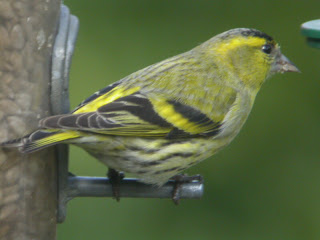
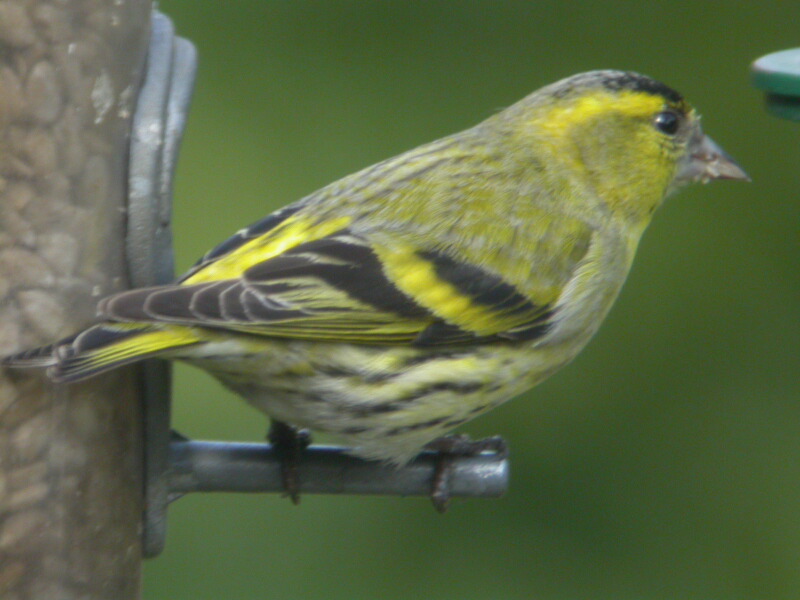
In fact, finches are much in evidence at the moment, with regular flocks of up to 7 Siskins and the occasional Lesser Redpoll feeding with Goldfinches in the Silver Birch trees.
Also, with the continuing presence of spawning frogs, a Grey Heron continues to try his luck when not scared off by movement from the house. Having said that a Common Buzzard has not appeared this year to feed on the frogs, a bird swooped in on March 13th and pounced on a poor unsuspecting individual before flying off to feed in a nearby tree.
Thursday, 10 March 2011
Frog Snatcher
An adult Grey Heron was trying his luck at catching the spawning frogs in the pond again this morning. I had thought that the frogs had finished for the year judging by the amount of spawn present, but in recent sunny days, another 10 to 20 have appeared. With their outstanding eyesight, Grey Herons will spook at the slightest movement, even through double glazed windows, so this record shot was taken whilst lying on my stomach with up stretched arms. When I stood up, he took off immediately with a loud 'craak' - but I'm sure he'll be back during a quieter moment. (Although there are several metal ornaments surrounding him, I assure you that he is not plastic!)


Tuesday, 1 March 2011
First Signs of Spring
Some very mild days over the past couple of weeks, with temperatures in double figures on several days, has helped with the onset of Spring. In particular, in my garden, frogs have returned to the pond to spawn. In fact, they have pretty much finished, which is quite early compared to other years. In excess of 100 frogs have created a huge batch of spawn that covers the northern bank of the pond. In past years, their frenetic activity has attracted one of the local Common Buzzards - it would swoop down, land in the water and walk about until it speared a frog in its talons, then fly up to a nearby oak bough and devour its catch. After about 30 minutes it would repeat the exercise. This would go on for many hours until it had had its fill. This year is the first year in many that this has not happened, maybe put off by a local black cat that has also taken a fancy to the movement despite best efforts to remove it.
However, this morning, March 1st, I opened the curtains and disturbed a Grey Heron that flew off from the pond. Another bird was perched on the garden shed, which followed its companion up and away. No further frogs have been seen, so I guess they have finished off the stragglers between them.
A few bumble bees have been seen, including 2 sightings of the now regular Bombus hypnorum, Tree Bee. It is surprising how over a few years this recent colonist has become firmly established.
Another recent coup has been the sighting of at least 4 House Sparrows, no more than 400 yards from the garden. I thought that this species had become extinct from this area, with only 2 garden sightings, the last being 6 years ago, so this was very encouraging. I even managed a scope view of a male and female in a distant hedge from the lounge, which is even better!
Blackcaps are quite regular visitors to the feeders at present, usually a lone female, but also a female and a male, so at least 2 maybe 3 birds. Bramblings are also fairly regular, but in small numbers. They usually build slightly in number in late Winter through March, but the maximum daily count so far is just 5 birds, 3 males and 2 females - still, always a delight to see. Siskins are also more regular this time of year before they depart to their breeding grounds.


 The other sign of Spring is the sound of the Tawny Owls' courtship song. Described as a 'xylophone trill' this rather musical un Owl-like low trill is made by either sex and can be heard most evenings at present. Hopefully, this is the precursor to another nesting attempt in the owl box - certainly at least one bird is seen fairly frequently roosting at the entrance to the box at the moment.
However, this morning, March 1st, I opened the curtains and disturbed a Grey Heron that flew off from the pond. Another bird was perched on the garden shed, which followed its companion up and away. No further frogs have been seen, so I guess they have finished off the stragglers between them.
A few bumble bees have been seen, including 2 sightings of the now regular Bombus hypnorum, Tree Bee. It is surprising how over a few years this recent colonist has become firmly established.
Another recent coup has been the sighting of at least 4 House Sparrows, no more than 400 yards from the garden. I thought that this species had become extinct from this area, with only 2 garden sightings, the last being 6 years ago, so this was very encouraging. I even managed a scope view of a male and female in a distant hedge from the lounge, which is even better!
Blackcaps are quite regular visitors to the feeders at present, usually a lone female, but also a female and a male, so at least 2 maybe 3 birds. Bramblings are also fairly regular, but in small numbers. They usually build slightly in number in late Winter through March, but the maximum daily count so far is just 5 birds, 3 males and 2 females - still, always a delight to see. Siskins are also more regular this time of year before they depart to their breeding grounds.


Sunday, 6 February 2011
Same old...
Not much of note to mention at the moment. A female Green Woodpecker that took a bath in the pond on 3rd February was a garden year tick. This species is usually more obvious in the late summer when youngsters often appear to feed on ants in the lawn. I remember returning home after the birth of my daughter to find one clinging to a curtain rail in the lounge and pecking the wall! The cats had obviously brought it in through the cat flap and then found it too scary and let it go.
 A male Blackcap has appeared a couple of times and small numbers of Siskins are now visiting the feeders as well as feeding with the local Goldfinches in the silver birch. One of these Goldfinches has possibly contracted the dreaded trichomonosis, as it was rather lethargic, puffed up and hopping around the patio in very un Goldfinch-like way.
 Flyover Starling and Skylark also made it onto the garden year list, which slowly climbs.
The moth species are equally low so far this year, comprising 3 macro and 2 micro species to date. I don't tend to start light trapping until at least March and rely on the kitchen and porch lights. Winter, Early and Pale Brindled Beauty have been attracted to date along with Agonopterix heracliana and Acleris ferrugana/notana.


The moth species are equally low so far this year, comprising 3 macro and 2 micro species to date. I don't tend to start light trapping until at least March and rely on the kitchen and porch lights. Winter, Early and Pale Brindled Beauty have been attracted to date along with Agonopterix heracliana and Acleris ferrugana/notana.
Tuesday, 1 February 2011
Woodcock
An up to the minute posting for once!
Literally 5 minutes ago, as I looked up from the computer and out of the front window, I watched the silhouette of a Woodcock flying north over the house along the edge of the adjacent wood - fantastic!
This is actually my second record of Woodcock following a bird in November 2007. That one flushed from the base of a holly bush just the other side of my fence as I walked to the shed. It almost gave me a heart attack as it exploded up and away through the wood!
BGBW
The RSPB's Big Garden Bird Watch took place last weekend. I duly spent my timed hour on Sunday morning looking at the back garden and had a few pleasant surprises and a few regular absentees, which seems par for the course with this event. I managed 15 species, of which a female Bullfinch was new for the garden year list - never a regular visitor. Another scarcity appeared in the oak tree in the form of a Stock Dove. 4 Lesser Redpolls alighted in the birch briefly before departing, being my first birds since January 1st. Lastly, 2 Bramblings, a male and a female, were not unexpected - numbers of this species have been very low this year, even though the Chaffinch flock numbers about 40 on some days.
Later in the day, a male Blackcap made a brief appearance in the lilac before flying next door - thereby missing the BGBW totals!
Later in the day, a male Blackcap made a brief appearance in the lilac before flying next door - thereby missing the BGBW totals!
Subscribe to:
Posts (Atom)